
The Odyssey, Memory, and Personal Narrative
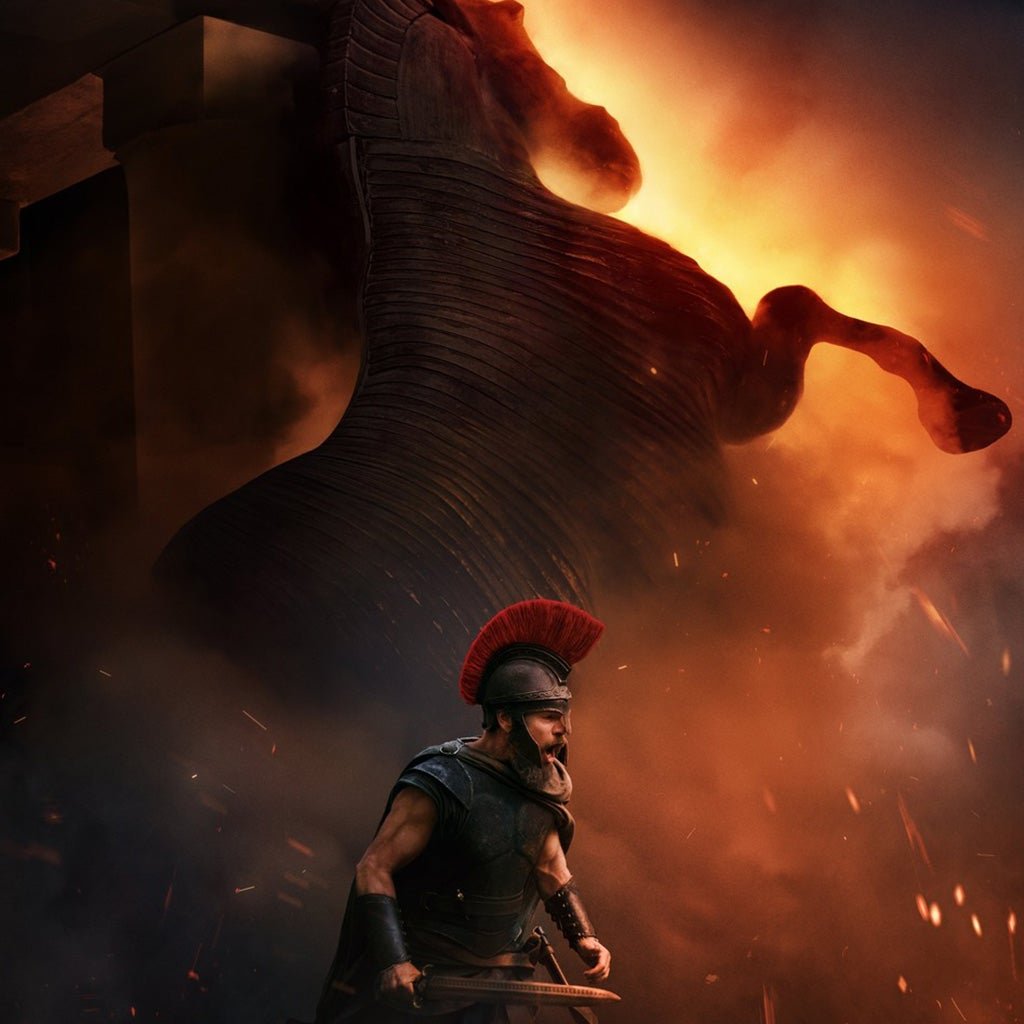
What Christopher Nolan’s interpretation of the classic story can tell us about ourselves.
(Note: Some mild spoilers for the 2026 film The Odyssey are included below.)
Stories and narrative form core components of just about everything we do…both as human beings in general, and here at the Inner Grove Collective, specifically. In his book The Stories We Live By, Dan P. McAdams observes that “human beings are storytellers” by nature, noting that story is present in basically every known human culture throughout all of history, giving us a crucial way to “organize our thoughts…heal [ourselves] when we are sick, and even move [ourselves] toward psychological fulfillment and maturity.” To put it just a bit more simply, stories help us make sense of ourselves and explain the world around us…especially when those things are strange and confusing, which they very frequently are.
You can see it throughout history: Various Native American traditions used narrative to explain the natural phenomena that shaped the world around them…while the Greeks and Romans basically came up with an entire pantheon of gods, goddesses, and weird monsters as a way of making sense of the peculiarities of both male and female psychology. When the world around us gets weird, we come up with a story that hopefully makes it make sense.
Or, as McAdams puts it: “We do not discover ourselves in myth; we make ourselves through myth.”
The Odyssey in Context
If there’s a story that’s truly a “tale as old as time,” the Odyssey is as good a candidate as any. As a key component of the original oral tradition of storytelling, the Odyssey is a prime example of the fact that we human beings like stories so much that they were central to our lives literally before we even had a way to write them down. And it makes sense, too: It was a big hit then, and we’re still finding new and interesting reasons to talk about it now.
At the time—the end of the Bronze Age, specifically—the world was an incredibly strange place, full of people, animals, and natural phenomena that we just didn’t have the names for yet. Was there really a terrifying group of man-eating giants out there? Or is it a little more likely that someone, at some point, encountered a race of people they had yet to hear about, meeting a group of individuals taller than anyone they had ever seen before? Stories, especially in a time like the Bronze Age, gave people a way to contextualize and talk about things they didn’t understand yet, making the world seem just a bit less scary, as a result.
Nolan’s Personal (and Global) Concerns
Adapting the Odyssey is obviously a decent challenge. There’s a lot to think about, but it’s not like the Odyssey is bursting with ideas or themes that are directly relevant to the moviegoing audiences of today. In fact, this is exactly what makes Nolan’s specific adaptation so interesting. By bending the story ever so slightly (as all good adaptations do), Nolan was able to tell a story that is deeply connected to his most personal concerns and anxieties…which fascinatingly pushes the themes and ideas of The Odyssey out to a truly global and generational scale.
For three movies now, Nolan has expressed a deep anxiety over the potential that we are already well in the process of irrevocably messing up the world for future generations. After addressing these concerns more directly in Tenet and Oppenheimer, Nolan finds a subtle way of addressing them with The Odyssey, folding them into questions about memory, legacy, and—perhaps most importantly—personal narrative.
Remembering What We Already Know
On a personal level, Nolan’s interpretation of the Odyssey directly involves a key tenet of the work we do at the Inner Grove Collective: remembering what you already know. For Odysseus, this literally means snapping out of a trance and remembering that he has a home, wife, and son he needs to get back to. In one of the few concrete changes Nolan makes from the source material, Odysseus is fed lotus flowers by the nymph Calypso, who keeps him stranded on an island instead of letting him return home from the war he’s just finished fighting. Eventually, he must remember that he has a life to get back to and return home.
It’s not entirely dissimilar from the work we do at the Inner Grove Collective…especially if you consider those memory-erasing lotus flowers as a metaphor for the behavioral and thought patterns we know we need to change, but would rather not confront. Those patterns can keep us feeling like we’re running in place: As much as we’d like to see a change, it can be easier to just keep going through the motions. But when we do inner work, we’re able to look at ourselves with new perspectives, discovering truths about ourselves that we might not have considered before…remembering, in a way, the things we already knew.
The Odyssey and Personal Narrative
Another subtle but powerful change Nolan has made to the source material involves the concept of personal narrative. To talk about this properly, though, we need to zoom out just a little bit. Throughout Nolan’s interpretation of the Odyssey, various characters make reference to the fearsome Sea People—an unknown population of marauders who have apparently been sowing terror throughout the region. Multiple characters express their fear that the Sea People might visit them soon, but what’s most interesting about this idea is that it’s actually based in history.
One of the things we know for sure about the Bronze Age is that, as it wound to a close…things got bad. As Jesse Millinek puts it in his book Destruction and Its Impact on Ancient Societies at the End of the Bronze Age, “…after the events of the years encircling 1200 BCE all was changed, many would say for the worse.” Everything just sort of fell apart, right around the same time, and there’s a lot of debate about why that might have been. At least one theory involves the “Sea Peoples,” a group “who themselves were only the victims of a corrupt system and a devastating drought that had gripped the Eastern Mediterranean.” The questions surrounding the societal collapse that came along with the Late Bronze Age have been plaguing historians for over a century and a half, but in The Odyssey, Nolan invokes this historical idea in a much more personal way.
As he makes his way home, Odysseus is forced to grapple with the way his own actions have rippled outward and changed the world around him…and not exactly for the better, either. Sacking Troy, vanquishing his enemies on his way home, stopping at nothing to reach his wife and son—these actions might have seemed noble to their core while he was doing them…but at a certain point, Odysseus realizes that, to the people on the other end of those actions, he has actually become a source of true terror.
What Personal Narrative Means at the Inner Grove Collective
Odysseus’ confrontation with the truth of his own personal narrative—and, more specifically, the shift in perspective he allows himself to undergo—very directly mirrors the work we do at the Inner Grove Collective in a fascinating way. Of course, our hope here is that you have the opposite experience, and that you realize that your personal narrative is a far more positive one than you had previously admitted to yourself…but the real magic lies in allowing yourself that shift in perspective and then integrating it into your personal narrative in a way that enables you to move forward positively.
Much like Odysseus’ shift in understanding about his own role in the world, much of the work we do here at the Inner Grove Collective doesn’t involve changing the facts of your personal story, so much as it involves interpreting those facts in a new and more positive way. A way that leaves you more at peace and confident that you can move forward to a place of happiness and fulfillment. And the important thing to remember is that, while we can’t always control the direction our experiences take us, what we can control is the way we react to them and take them with us as we move forward.
This is where integration becomes key. It’s not enough to just know the road is there—we give you a way to walk it, too. The experiences we have during something like a Magic Nights event, for example, typically come to us from outside our normal modes of experience. The information can be difficult to interpret, and those interpretations can, at times, be personally challenging. Integration helps you make sense of what you experienced during your journey, giving you a positive framework that helps you utilize it to your personal advantage moving forward.
In other words, when experience opens a new doorway, integration helps you walk through it.
